Reading up on and researching which barefoot shoes to buy can be overwhelming. I’ve put together this 3 step cheat sheet to stop the decision paralysis – in my opinion the best way to sell the barefoot experience is to just wear them and see how much better they feel!
The information is for everyone of all abilities and all ages who want to get started with foot-friendly shoes. There is always time to delve deeper later – you can find low cost options that require very little ‘buy-in’ to get started.
Step 1: Measure Your Feet
Barefoot retailers almost always list the interior length of the shoe, if not the sole length. This takes out lots the guesswork of sizing – don’t just order your ‘usual size’. It can vary too much between brand and even within brands.
When you have your foot length, e.g., 27cm, add some wiggle room for your toes. How much this should be depends on type of shoe, if your feet are growing, etc. Most adults are fine with approximately 1cm extra space in most shoes. Less for sandals or if you like a closer fit. More for boots you will wear with thick socks. Children may need 1.2cm.
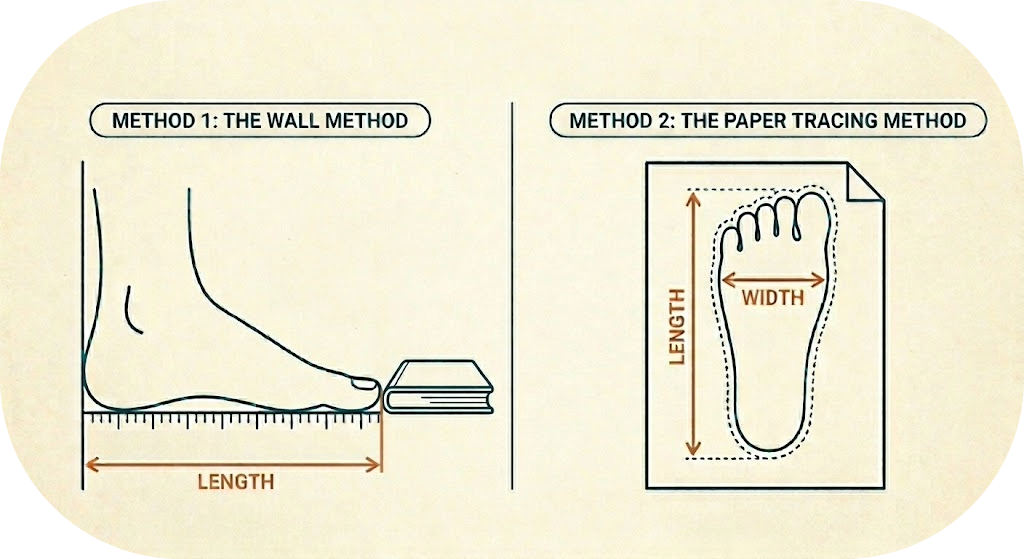
Accurately measure your foot length using on the following methods below:
The Wall Method (faster):
- Stand with your heel against a flat hard surface, like a wall.
- Place a hard, straight object (like a book) parallel to the wall at the end of your longest toe. Make sure you are putting your weight on your foot.
- Remove your foot and measure the distance from the wall to the object to get your foot length in centimetres or inches.
- Repeat with the other foot, in case of size variation. Take the longest measurement as your length.
The Paper Tracing Method (more detailed):
- Get a sheet of paper that is longer than your foot (cardboard is fine too, but make sure the squashing doesn’t distort the tracing). A4 / Letter works for most.
- Place the paper on a hard floor against a flat vertical surface like a wall and step onto it. Make sure your heel is back against the wall.
- Trace around your foot, keeping the pen or pencil vertical. You can’t go behind the heel – don’t worry. Just do a rough outline of the toes, not between each one!
- Step off and measure from the centre of the back edge of the paper to the end of your longest drawn toe – you can draw a line direct even if it’s diagonal, or measure from a perpendicular line across (see the infographic below).
- This method also allows to measure width: just measure the widest point of your foot tracing. Some retailers sell multiple widths, or at least provide the width measurement.
Step 2: Get Some Shoes!
Before agonising over the transition, just go ahead and buy some shoes that are within budget, your size, and that you like enough to wear outside.
I’ve listed some options below, but almost any barefoot shoe will do! See the below categories for inspiration. Buy one pair to start with and get a feel for what you like. I’ve linked the brand directory below, but I recommend you don’t spend hours clicking through if you’re not sure what you want yet.
Budget option: Cheap New barefoot shoes (~ £60 or less for adults, ~£25 or less for kids)
Barefoot shoes can be sold at a bit of a ‘premium’, simply because they are more of a niche market and require different lasts to manufacture etc., as well as some options being made in the EU / USA and being of high quality.
There are still lots of relatively low cost options! Remember to check size charts carefully before purchase, never just buy your ‘usual size’.
Direct From China Options
The upside is you get more bang for your buck. The downside is the shipping time and the longer distance returns. I really rate Tipsietoes as I have a lot of experience with their kids shoes and can’t find anything close to as cheap for the quality. I don’t have personal experience with their adults shoes, but hopefully will do soon!
- Tipsietoes sell direct on Aliexpress and make exclusively barefoot shoes for children and adults. They have roomy toe boxes and nice designs.
- Some kids models:
- Some adults models:
- Women’s stylish leather sandals (dupe of a more expensive brand – Shapen!)
- Unisex / Men’s high top leather trainers
- Storefront – many more models available: loafers, ballerinas, etc.
- Hobibear trainers. These are even cheaper, but materials are cheaper and not all models are truly barefoot. Still lots of nice options. Also available on Amazon, see the Amazon section.
- Some kids models:
- Some adult models:
- Storefront – NB: not all models are fully ‘barefoot’ – check titles and descriptions to look for keywords like ‘barefoot’ and ‘zero drop’.
High-Street Options
More and more high street retailers are stocking barefoot lines. Kids shoes may be more easily found in-store as adults models are currently mostly online only.
- Zara, a selection – search their site for ‘barefoot’ if you want to see more models. These are an excellent price and easily can be returned:
- Tu Clothing at Sainbury’s have children’s barefoot shoes now
Amazon
Easy returns and usually quick shipping. You can get budget ‘no name’ and some more established brands like Hobibear from Amazon.
- Hobibear adult unisex canvas trainers
- Another similar Hobibear option
- Hobibear kid’s mesh trainers
- Watershoe style, like these IceUnicorn trainers. Good for daily wear, not just water. Lots of similar options with this toe indent sole style.
Second Hand
There are dedicated reselling groups on Facebook and there are options like Vinted and eBay. Some websites resell their own branded shoes second-hand too, such as Vivobarefoot and Earthrunners.
- Revivo – the official reseller of Vivobarefoot second hand shoes.
- ReEarthrunners – the Earthrunner’s official reselling page for refurbished or factory defect sandals. [Use code 5TF for 10% off]
- Vinted, eBay, etc.: search for ‘barefoot shoes’ if you are unsure what brands to search.
- Facebook groups: UK barefoot sales group, UK barefoot “friendly” sales group, Another UK sales group, Global / US-mainly barefoot sales group. (There are groups for other regions, just search on Facebook).
Step 3: Begin the Transition
How slow you need to go is personal, but going ‘cold turkey’ from a lifetime of conventional shoes may cause injury. Your muscles will be used in ways they haven’t been before and will become fatigued easily. The younger, the better, as conventional shoes have had less time to weaken feet.
Children who are starting to wear shoes don’t need special ‘transition’ considerations – they’re build for barefoot. Older kids may need to take it slow. Adults will need to take things the slowest.
Once you have a pair of shoes, I recommend the following:
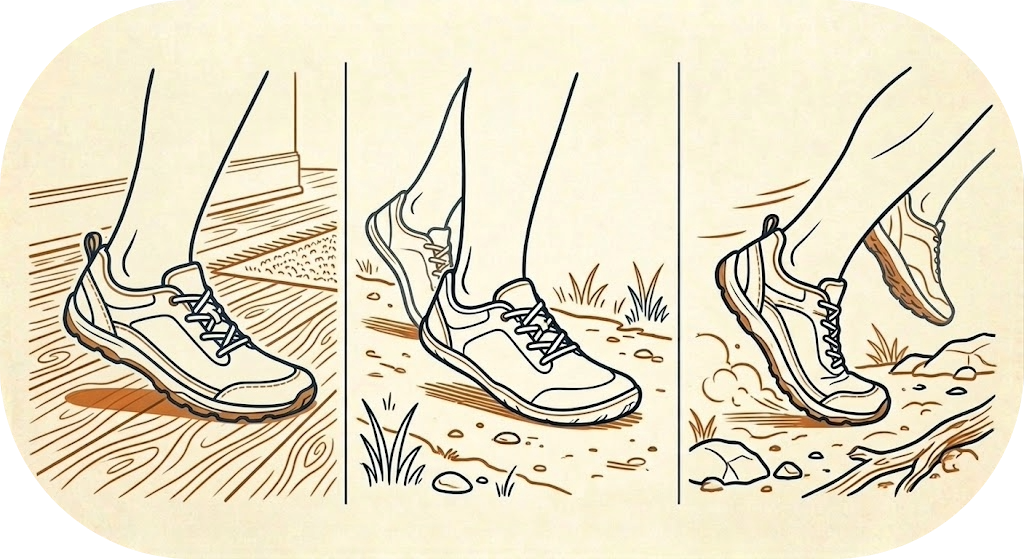
- Wear them around the house daily. Start with an hour or so for the first few days. If your feet or legs feel sore or fatigued, just keep to indoor use until they adjust.
- Move on to wearing them outside for short walks, no longer than 15-20 minutes or so. Again, try this for a few days and wait for your feet to adjust.
- You can then start wearing them for longer walks, on errands, etc. don’t increase mileage much, because any injury will set back your progress.
- Once walking comfortably, you can introduce some sports if you wish. Low impact sports like weight lifting will be of little issue. Running needs to be taken very slowly! Start with short runs and ensure you adjust your gait so that you are not over striding or coming down hard on your heels. Your running form will need to change, most likely.
Some tips for the transition:
- Add an insole or don’t remove the provided one if the sensation is too much and you want more cushioning. Make sure the insole is appropriate for the barefoot shoe: flat, no arch support, foot shaped. This also helps fill out shoes that might feel a bit big.
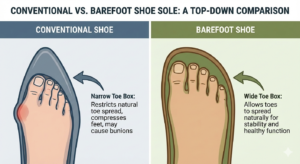
- If you buy what appears to be the right size and they feel a little bit big, keep in mind your toes and possibly feet in general will spread and even lengthen slightly. This is a sign your feet were being compressed in conventional shoes, not a bug!
- You can buy specific “transitional” shoes that are not barefoot. They usually compromise on the sole thickness or the drop from heel to toe. These can be useful for some, but there is a risk you will soon “outgrow” them and wish for something more minimal.
- Over time you will probably be using your “normal” shoe collection less and less, to the point you may want to replace them all with barefoot shoes. Many people find returning to conventional shoes awful after realising how shoes should feel. Watch out.
Hopefully this guide was of some assistance – check out the link below to dive deeper into what makes a barefoot shoe and the why of transitioning.